When you have one of these you are basically leaking Cerebral Spinal Fluid (CSF) which will only add to your troubles (and as you can imagine this is going to be a bigger issue than a tear in your eardrum)
Bear in mind they sound ominous but there are almost no reliable statistics to go on to get a sense for how common they are and what it really takes to get one.
I’ve got a big hunch these days that ETD is way more common … (but just a hunch)
Standard technique for visually confirming a fistula is prolonged examination with microscope and asking the anaesthetist to increase intrathoracic pressure. The exit of perilymph is rarely rapid, but episodic and often appearing a tiny bead with a changing light reflex, reappearing after it is suctioned. However, surety that it is not clear local anaesthetic fluid remains a problem.
Just a random thing. Somewhere read that you can test for PLF with a fluid/pill I dont remember. You take it and it does something to the fluids inside the ear, probably decreasing them, if you feel better tou have PLF if not maybe its not.
Kon, stop obsessing about PLF, ototoxicity or neurotoxicity if you believe you have VM. I did freak out today for no reason thinking i had PLF and all i was having was a bad VM day !
I have a very reliable test for VM. Take a migraine med and say your brain freaks out and you get super duper dizzy, you have VM ! Eventually your brain will acclimate to the new med but the initial freak out confirms VM !
This paper is bogus . There is not a single PLF surgery known to man that does not have post-op conductive hearing loss. If that is not documented, I doubt everything that is written.
I have strong evidences for all these sadly, also my biggest problem is with eyes like they dont communicate. So its difficult to believe its VM when I feel my dizziness and all the symptoms come from my vision. I am not saying that my eyes are the problem but something that affects my eyes (inner ear,brain itself, etc I dont know)
Almost all my symptoms are tied to vision. Do a search here for visual issues. It’s very common with VM. I can barely see this screen right now thru the visual snow, halos and double images. I refer to this condition as ‘morning’.
In addition my vision is bad/blurring/wobbling when I am walking or moving my head from side to side. I am feeling that is some kind of vestibular loss.
Yep. Common with VM. I’d argue that’s practically diagnostic of VM. And easily one of the most vexing symptoms. Effexor helped get that under control for me.
I highly doubt it about the vision stuff. I dont know I feel like VM is just a diagnosis when you dont know what is really going on while there are more accurate diagnosis for your symptoms.
You are driving yourself crazy looking for something that doesn’t exist - a definitive diagnosis with defined mechanisms and etiology. Come back in 50 years and maybe they’ll have it. In the meantime, accept VM is as close as we’re likely to get. Then find a medication regimen that works for you. And a therapist to help you deal with your anxiety and grief.
The problem is that of you have another disorder you probably need pther meds or not meds at all. For example I wrote to another thread that if you have bilatera vestibular weakness or loss you should avoid vestibulo suppresants.
Dont you think that from all the specialists you saw and all the tests you had they wouldn’t have found bilateral vestibular weakness? Give the medics some credit. It’s pretty unusual and from what I read years back would have quite a dramatic start, like you’d lose your balance completely and be unable to walk until your brain compensated to a degree. You’d be pretty ill I’d say and from what you’ve written so far I couldn’t see any evidence of you having experienced that. Common things are common. MAV is common. Don’t gamers work on probability. Perhaps not.
Kon, I get where you are coming from to a significant extent. We all want an answer as to what is causing our issues, especially since they can be exceptional extreme, especially at the start.
I also get that you need an answer and there is a lot of uncertainty, especially so since I’m certain MAV is just a diagnosis and not a well defined aetiology. In fact, causes appear to vary so much, and many are unknown, how could it be?
At some point, however, you are going to have to give up searching for a reason and commit to following a treatment regime to see how you can best reduce your symptoms.
A MAV protocol is reasonably conservative (no surgery) and is a good place to start.
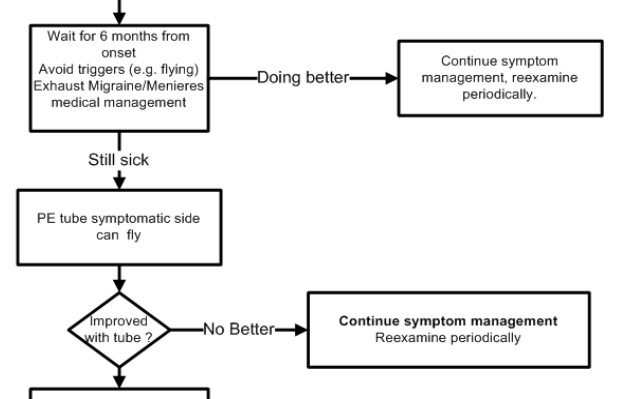
In fact even if you had a PLF, look at Hain’s workflow for treatment of PLF:
So you see PLF & MAV can clearly appear so similar they even er on the conservative side and recommend MAV treatment for a while, before trying a tube in the ear drum …
This is because they expect the thing to heal spontaneously in any case, or in fact not exist in the first place!
The ‘wait and see’ approach is a good one - time is a definite help! Be patient, things may well improve over the course of 2 years without you having to do anything but tolerate the symptoms and medical side effects.